ev-cloud is an OCPP gateway and OCPP proxy for charger connectivity and multi-backend routing, with an OCPI gateway for roaming—so operators change backends without rewiring the field.
Why is EV charging infrastructure so hard to integrate today?
EV charging integration breaks at the protocol layer, where overlapping OCPP versions and vendor-specific dialects turn every charger-to-CPMS connection into a custom project. ev-cloud exists as an OCPP gateway and OCPP proxy (plus OCPI gateway) so operators stop rewriting plumbing for every new hardware or backend decision.
If you've ever tried to integrate an EV charger with a Charge Point Management System (CPMS), you know the pain. OCPP versions proliferate — 1.5, 1.6, 2.0, 2.0.1. Each vendor implements the OCPP specification slightly differently. Each CPMS expects a specific dialect, and the gaps between them rarely show up until a charger is already in the field.
The result is predictable: integration projects that stretch for months, bespoke translation layers that break with every firmware update, and entire engineering teams dedicated to keeping the plumbing alive. We've seen this pattern across fleets, parking operators, utilities, and eMSPs. It is not a skill issue. The protocol layer is genuinely broken. For the deeper protocol background, see our ultimate guide to OCPP.
What is ev-cloud and what does it do?
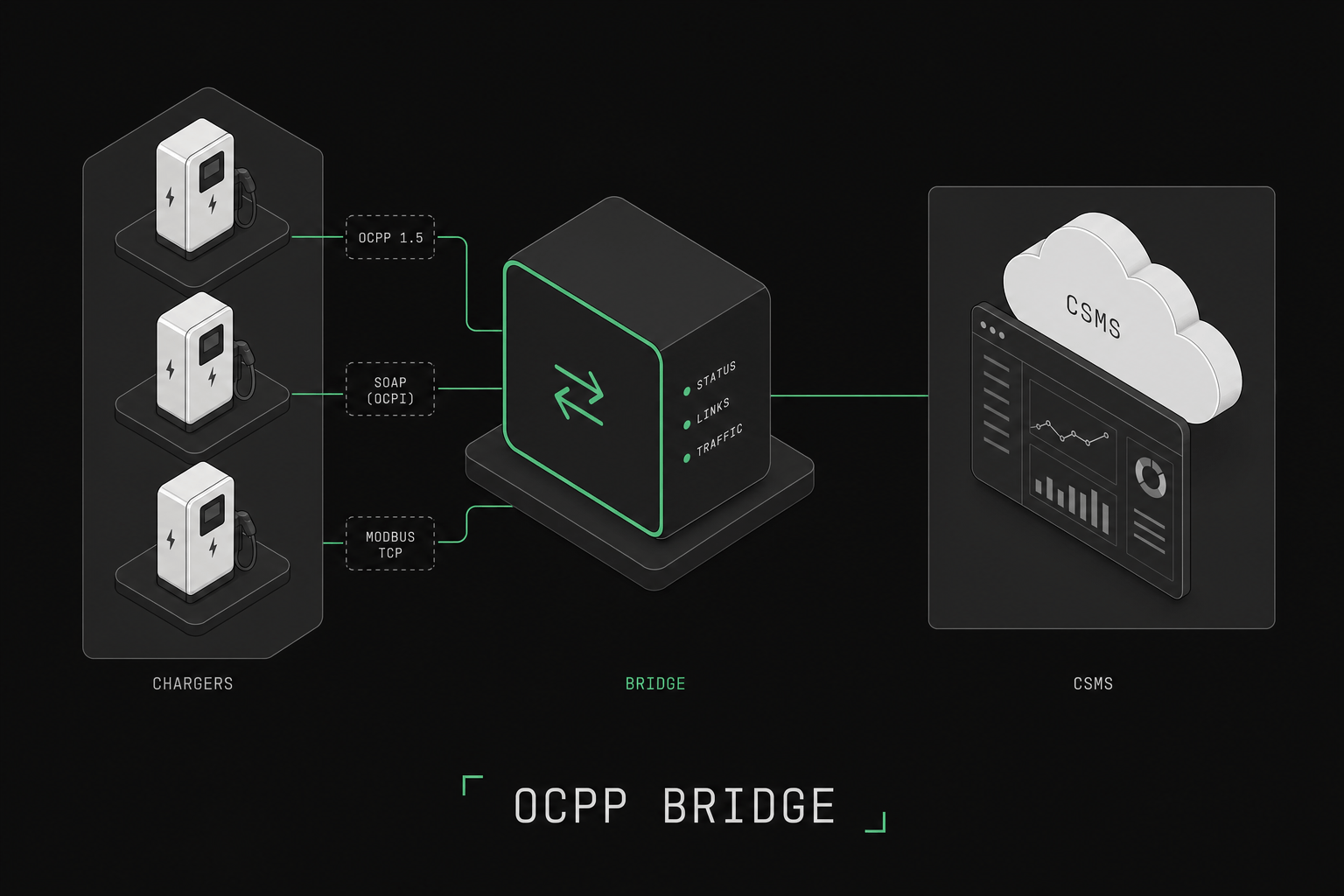
ev-cloud is a universal OCPP bridge: a network-level broker that sits between your chargers and your management systems (CPMS), normalizing protocol and routing traffic from a single endpoint. You connect chargers once, then express translation, routing, and downstream integrations as configuration instead of charger-by-charger code.
The bridge handles four jobs operators usually stitch together by hand:
- Protocol translation — OCPP 1.6 ↔ 2.0.1, handled transparently so chargers and backends never have to agree on a version.
- Multi-CPMS routing — fan a single charger's messages out to multiple backends simultaneously.
- Data ownership — every message is stored and queryable in your own schema, not locked inside a vendor dashboard.
- Lower lock-in pressure — change backend strategy without touching charger configuration in the field.
Why a bridge instead of point-to-point integrations?
Point-to-point integrations couple every charger model to every backend you run, so complexity grows with the product of both. A bridge collapses that into one normalized seam. In mixed-fleet rollouts, the failure usually shows up as one vendor's MeterValues payload that a second CPMS silently rejects. Centralizing translation means you fix that once, in configuration, rather than patching each charger group. New hardware or a new backend becomes an additive change, not a migration. To go deeper on roaming-side integration, see our OCPI guide.
How the ev-cloud architecture works
ev-cloud runs as a persistent WebSocket proxy with a stateful message router. Each charger holds one long-lived connection to the bridge, and every OCPP frame is inspected, transformed when needed, and dispatched to the configured upstream backends. Chargers see one stable endpoint regardless of how routing changes behind it.
The design choice that matters most is statefulness. OCPP is conversational: a BootNotification response sets heartbeat intervals, a StartTransaction returns an ID later messages depend on, and reconnections must resume cleanly. A naive stateless proxy loses that context and desyncs the charger. ev-cloud tracks per-connection session state so transformations stay coherent across the full message lifecycle, even when one upstream is slow or temporarily unreachable.
Charger ──WebSocket──▶ ev-cloud Bridge ──▶ Primary CPMS
                              │
                              └──────────▶ Secondary CPMS (optional)
                              │
                              └──────────▶ Your data warehouse
How does message routing and translation work?
Routing is rule-driven, not hardcoded. Each inbound frame carries a charger identity and message type, and the router maps those to one or more upstreams. A StatusNotification might go to your primary CPMS and your warehouse; a RemoteStartTransaction from a specific backend routes back to the right charger. Translation sits in the same path: when a 1.6 charger talks to a 2.0.1 backend, the bridge rewrites field names, enums, and structure so both sides stay spec-valid. Because rules live in configuration, adding a backend rarely means redeploying anything in the field.
How is OCPP data stored and made queryable?
ev-cloud stores a full copy of every exchange — BootNotification, StatusNotification, MeterValues, StartTransaction, all of it. That gives you a real-time event stream and a queryable history in your own schema, with no extra instrumentation on the chargers. In practice, operators use this for billing reconciliation, uptime reporting, and debugging field faults without filing a vendor support ticket. Owning the raw OCPP record is what makes data ownership a practical guarantee rather than a marketing line.
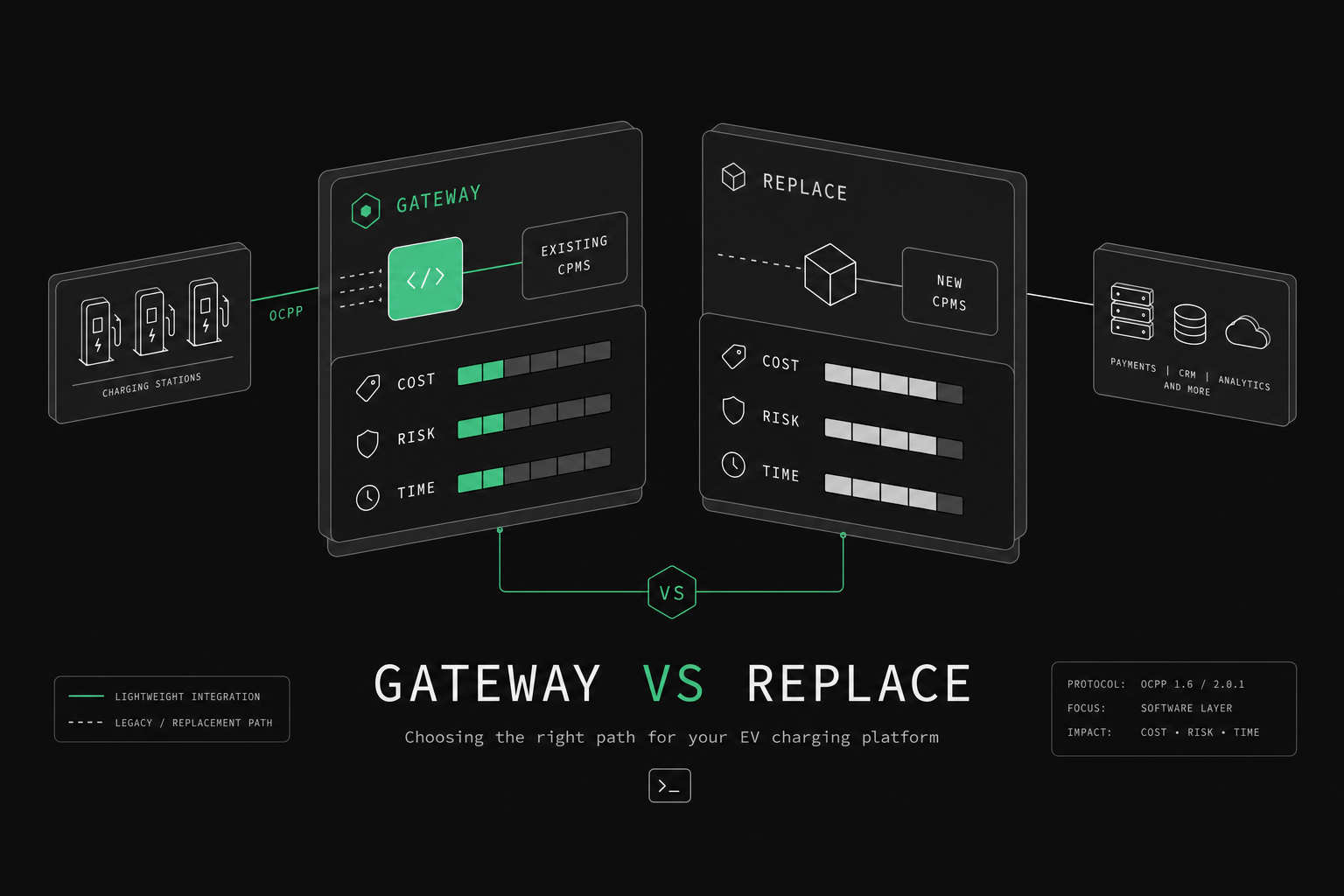
Bridge vs. direct CPMS connection: which fits your fleet?
A direct charger-to-CPMS connection is simplest when you run one hardware vendor and one backend forever. A bridge earns its place the moment you have multiple vendors, plan to migrate, or need your own copy of the data. The table below frames the trade-offs operators weigh most often.
| Consideration | Direct CPMS connection | ev-cloud bridge |
|---|---|---|
| OCPP version handling | Charger and CPMS must match | Translated transparently |
| Multiple backends | One at a time, reconfigure to switch | Simultaneous routing |
| Backend migration | Re-point every charger in the field | Reroute in configuration |
| Data ownership | Lives in vendor system | Stored in your schema |
| New hardware vendor | New custom integration | Additive config change |
| Best fit | Single-vendor, single-backend setups | Mixed fleets, migrations, multi-CPMS |
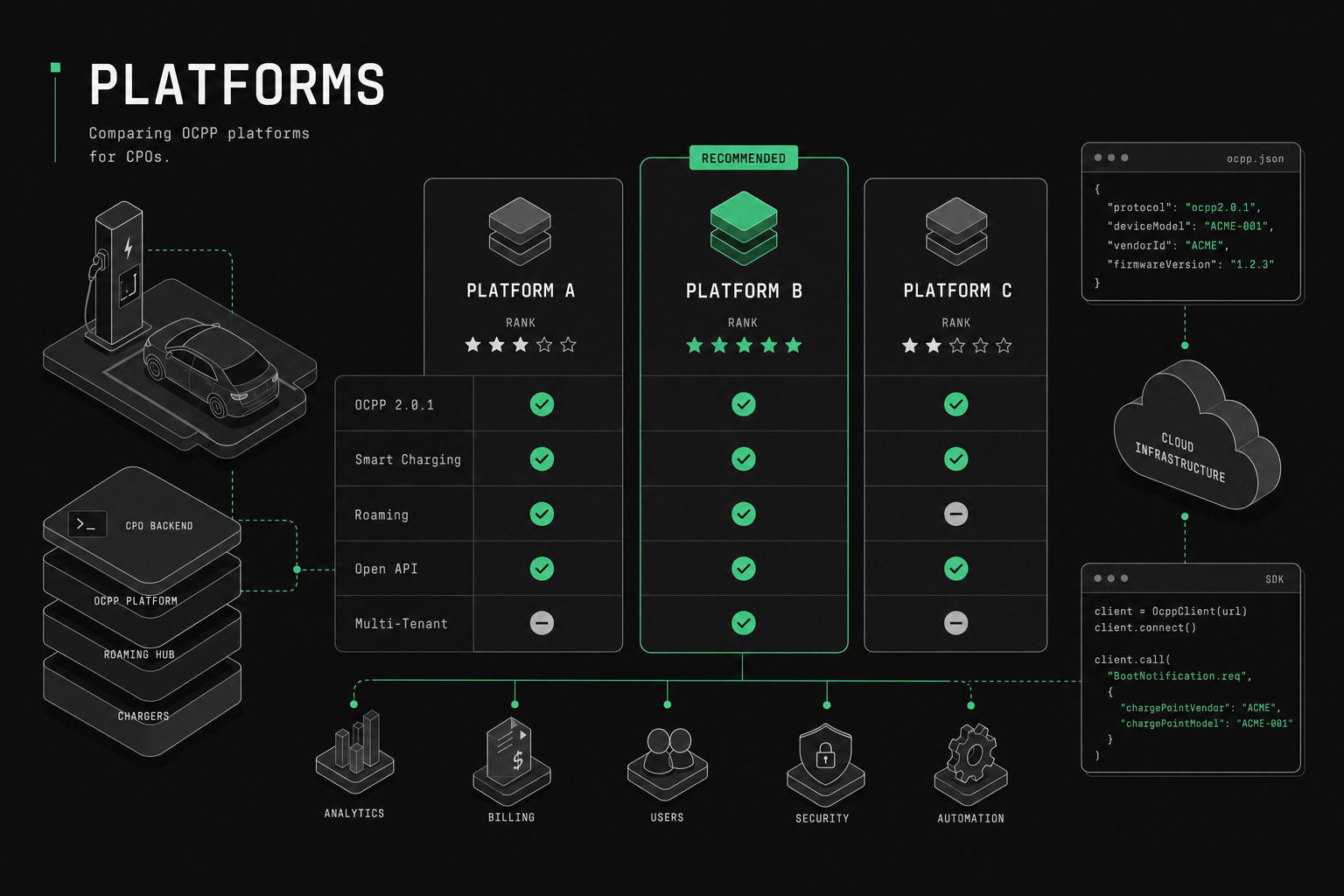
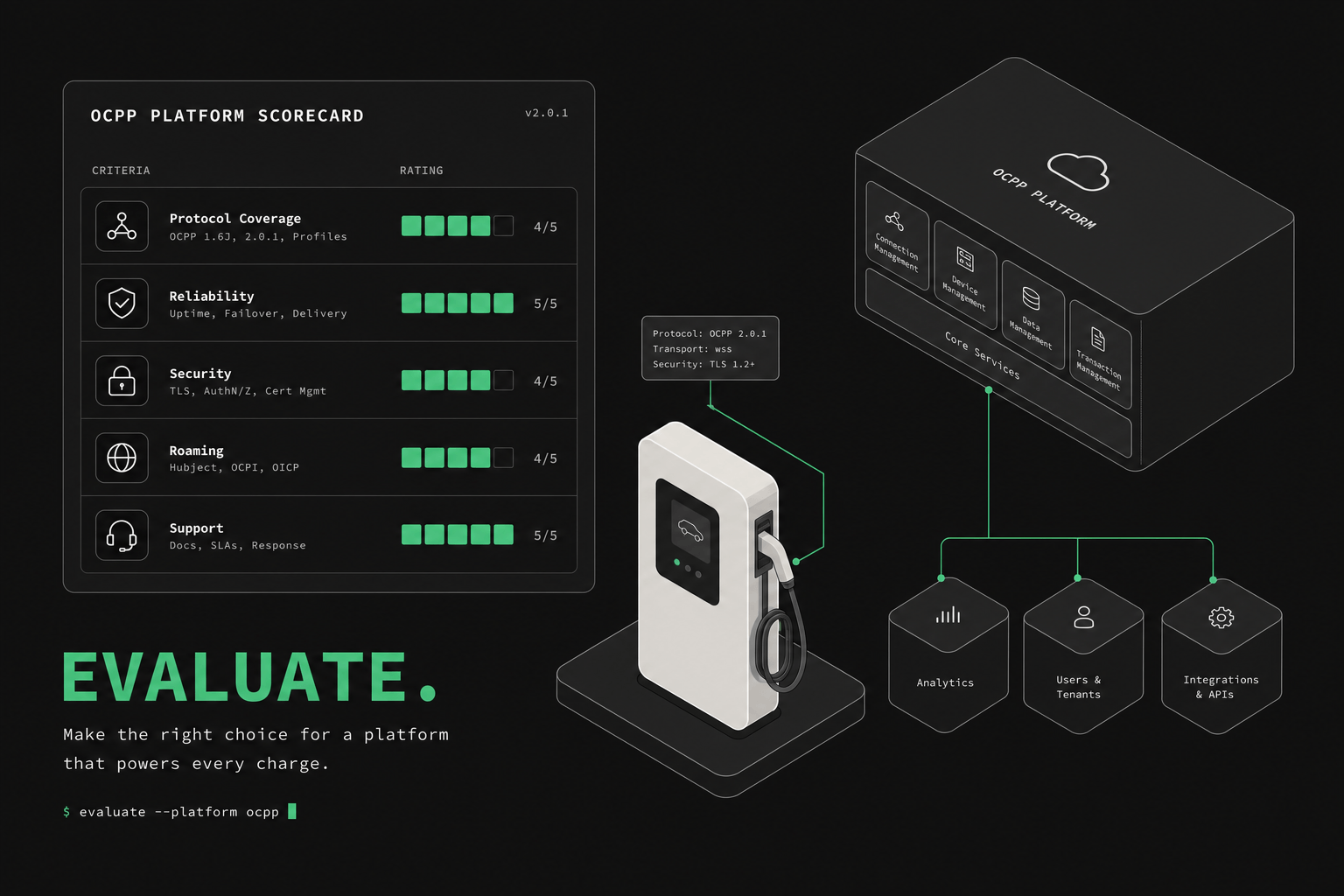
For a structured way to compare platforms against these criteria, the OCPP platform buyer guide and the CPO RFP checklist walk through the questions worth asking.
The ev-cloud roadmap
ev-cloud ships today with OCPP 1.6 and 2.0.1 support, and the roadmap extends the same bridge model into roaming, smart charging, and real-time events. The goal stays consistent: keep one stable seam for chargers while the capabilities behind it grow.
Near-term work focuses on three areas:
- Native OCPI integration for eMSP roaming, so the same platform that owns your OCPP traffic can broker roaming sessions and CDRs.
- Smart charging profiles and load management APIs, letting operators apply charging profiles across mixed fleets through one interface.
- Webhooks and streaming for real-time event processing, turning the stored OCPP stream into live triggers for billing, alerting, and analytics.
If you're evaluating architecture right now, start with the solutions hub, then get in touch when you want to test the bridge against your own fleet.
Frequently asked questions
What problem does ev-cloud solve first?
It solves the protocol and routing layer between chargers and management systems. Operators can scale, migrate, and integrate without constantly rewriting OCPP plumbing. The bridge removes the per-charger translation work that usually consumes engineering time and stalls rollouts.
Is ev-cloud only for new deployments?
No. It is especially useful in brownfield environments where teams need to preserve existing chargers or backends while modernizing gradually. Because chargers keep one stable endpoint, you can introduce the bridge without re-flashing field hardware.
Can ev-cloud route to more than one backend?
Yes. Multi-backend routing is one of the core reasons to use the platform, whether for migration, resilience, or parallel analytics. A single charger's messages can reach a primary CPMS, a secondary CPMS, and your warehouse at the same time.
Does the bridge change what chargers see?
No. Chargers keep one stable OCPP endpoint. Routing, translation, and backend changes happen inside the bridge as configuration, so field firmware stays untouched and integrations evolve without site visits.