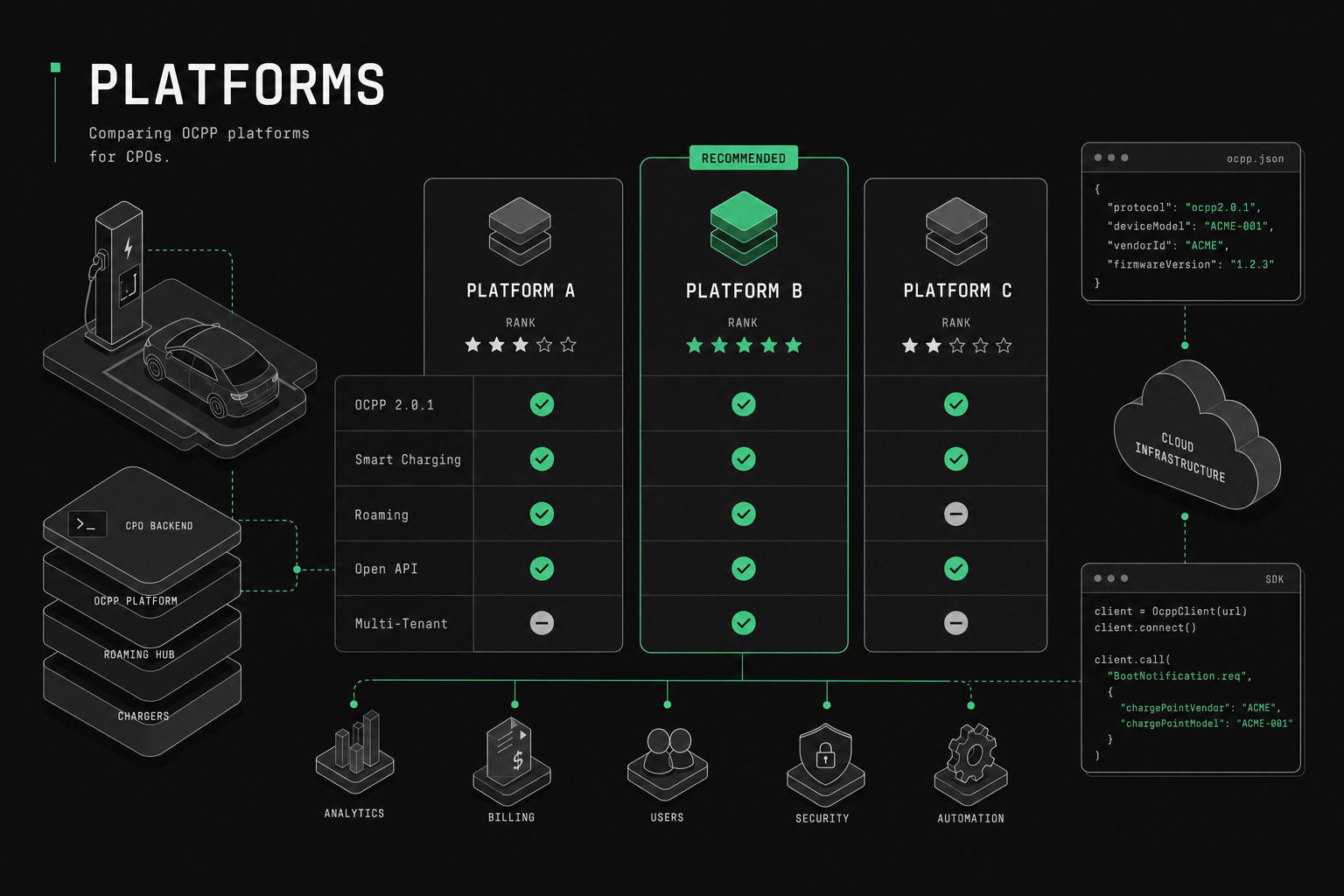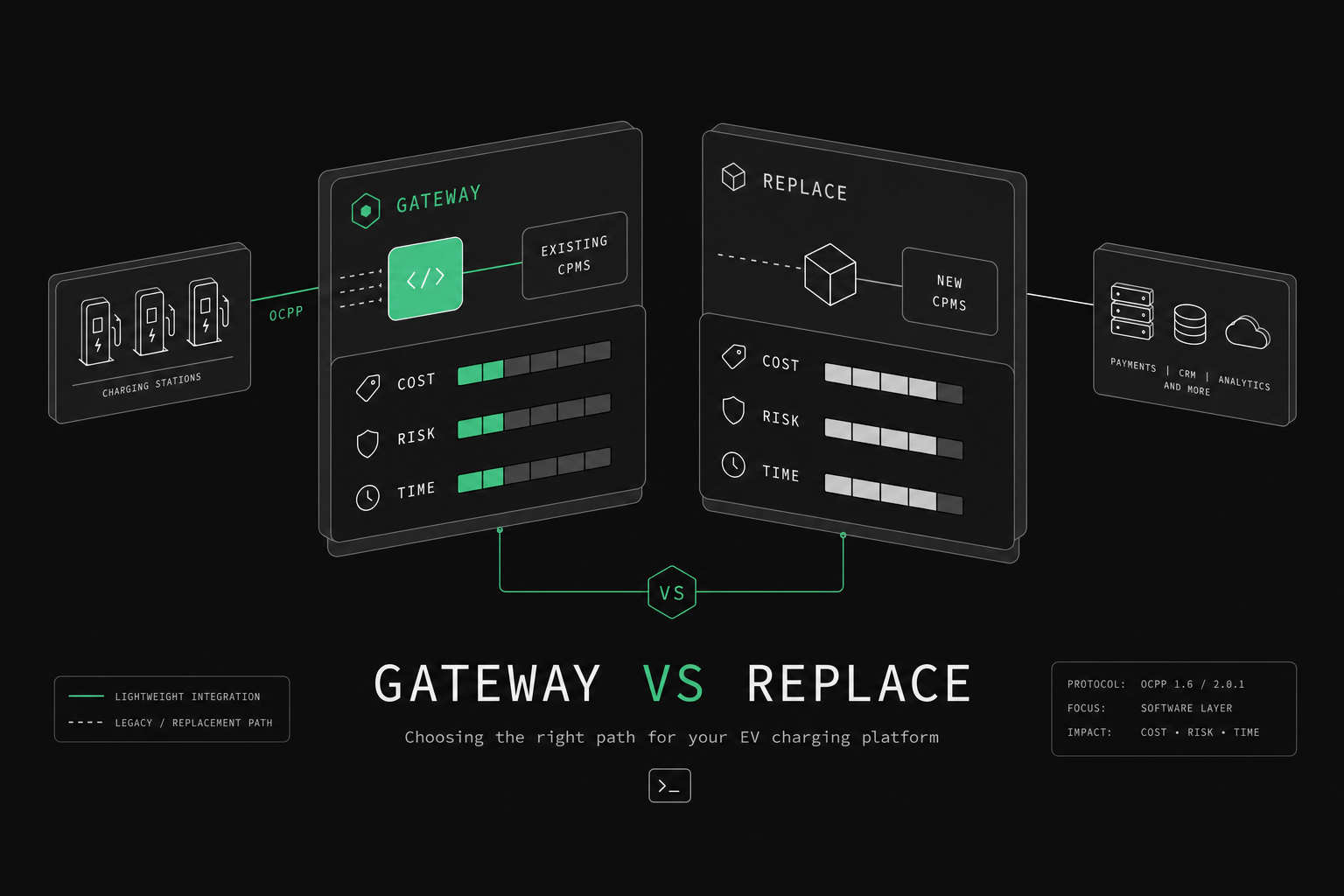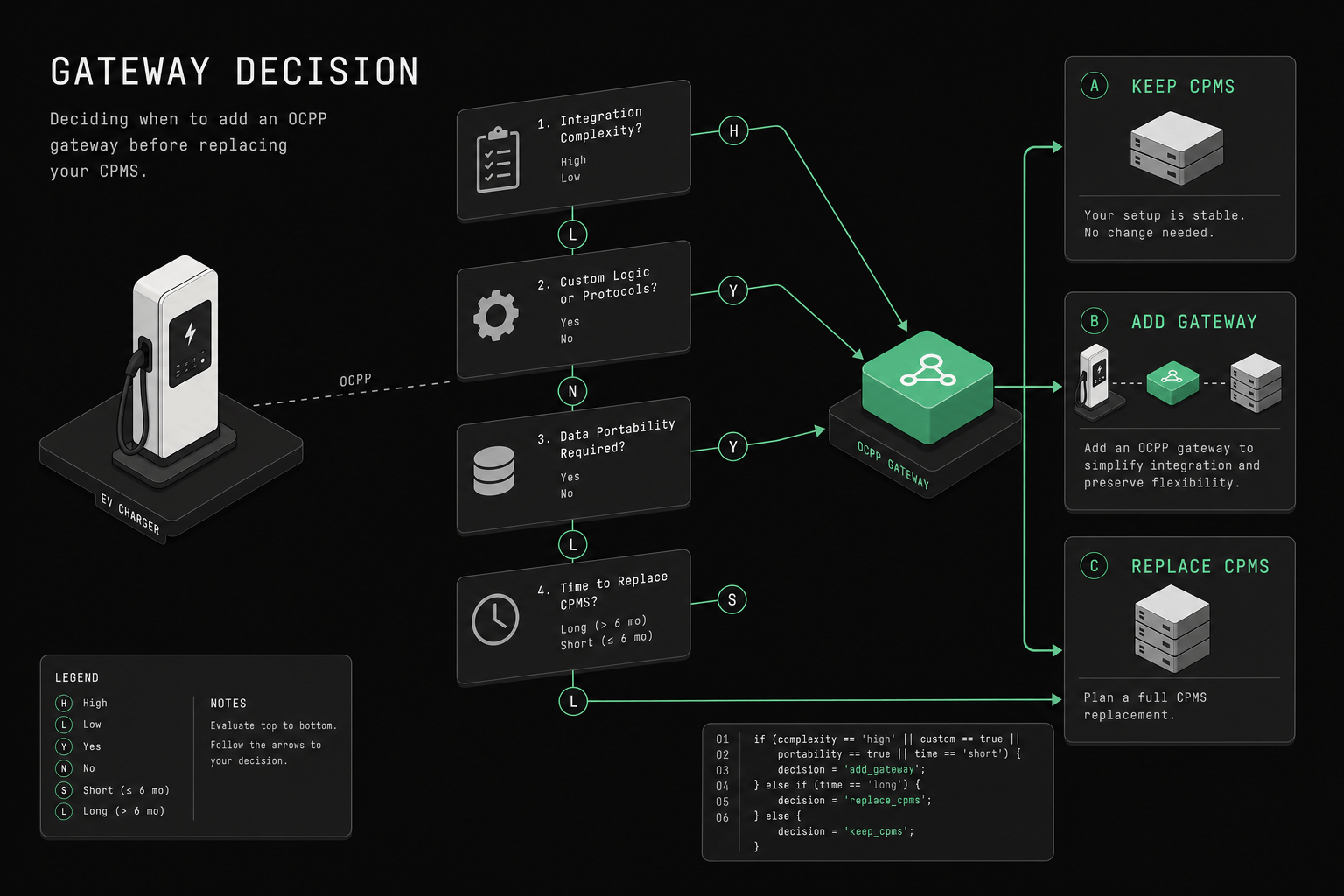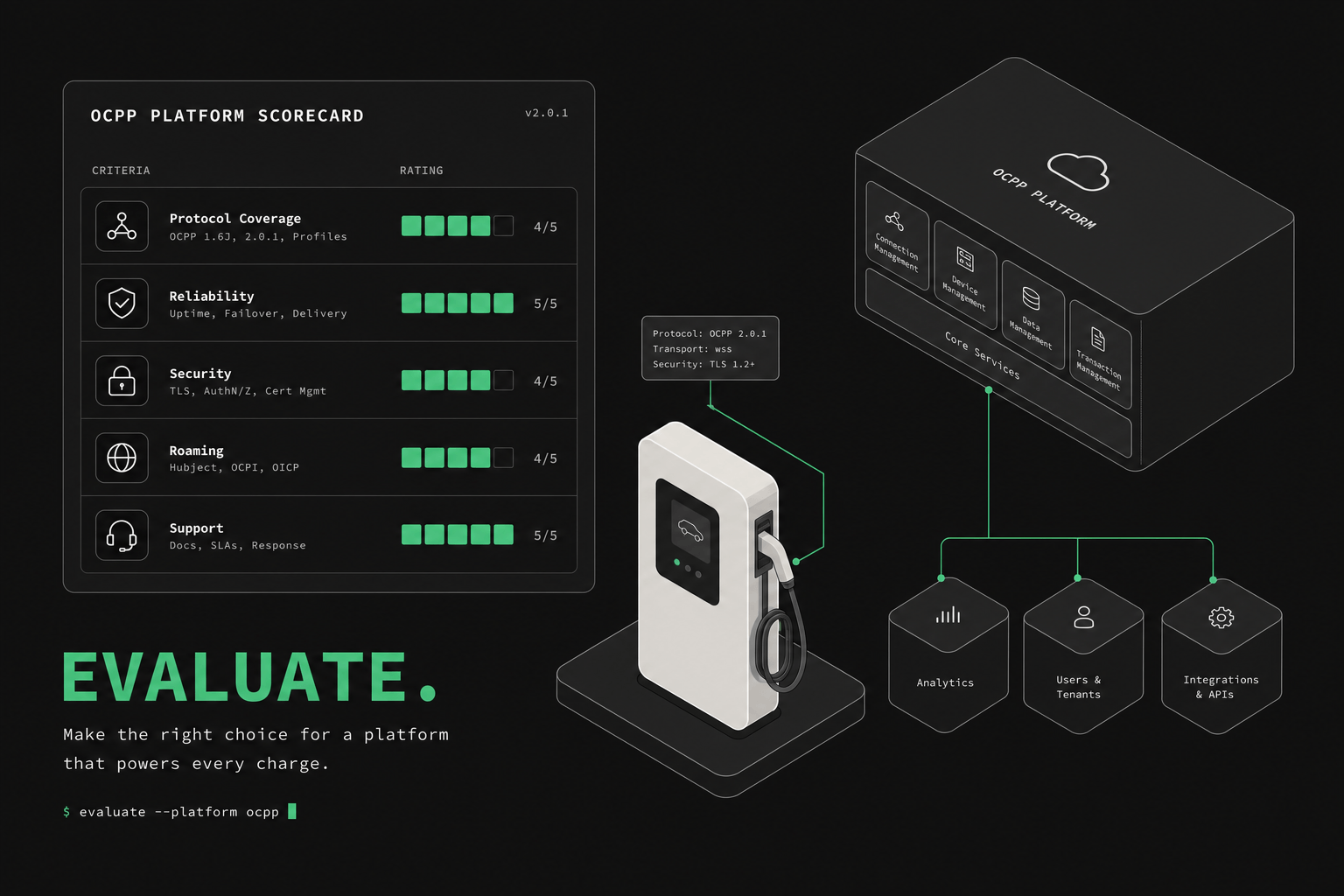
Evaluate an OCPP platform on migration flexibility, multi-backend routing, mixed-fleet depth, and data ownership—not on a yes/no OCPP checkbox. Decide gateway/proxy vs full CPMS by where your risk lives.
What should you actually evaluate in an OCPP platform?
Evaluate an OCPP platform on what it lets you change later without breaking operations, not on whether it ticks the OCPP 1.6 and 2.0.1 boxes. An OCPP platform may mean a full CPMS, an OCPP gateway, an OCPP proxy, or a hybrid. For CPOs, products that look identical on a feature list diverge sharply once you need to add charger brands, migrate off a legacy backend, connect OCPI roaming partners, or export your own data. Those change scenarios—not the protocol checkbox—separate durable infrastructure from a polished dashboard you will eventually replace.
Product shortlist anchors: OCPP platform overview · OCPP gateway · OCPP proxy.
Most OCPP evaluations go wrong because teams ask the wrong first question.
They ask: "Which platform supports OCPP 1.6 and 2.0.1?"
Almost every serious vendor will say yes.
The harder and more useful question is:
What do we need this platform to let us change later without breaking operations?
For most CPOs, that means:
- Adding new charger brands
- Migrating away from a legacy backend
- Connecting to roaming or payment partners
- Keeping access to operational and billing data
- Running parts of the stack in parallel during transition
If a vendor makes those changes painful, the fact that it "supports OCPP" is not enough.
1. Evaluating OCPP protocol support
Protocol support is table stakes, not a differentiator. Almost every vendor claims OCPP 1.6 and 2.0.1, so the useful question is how well the platform tolerates the chargers that implement the standard imperfectly. Start with the basics, then probe the edges.
Start with the basics:
- Which OCPP versions are supported today?
- Is support production-grade or roadmap-only?
- Does the platform handle mixed fleets?
- What security options are supported in practice?
Then push further:
- How does the vendor normalize charger behavior across brands?
- How are firmware quirks handled?
- Can the platform expose raw protocol events when debugging matters?
- What happens when a charger only partially implements the standard?
If your team is still deciding how OCPP relates to roaming and partner integrations, read OCPI vs OCPP first. That distinction shapes architecture and budget decisions early. For a deeper dive on protocol versions, see the OCPP 1.6 vs 2.0.1 migration guide. You can also find the official OCPP specifications on the Open Charge Alliance website.
2. Why does migration flexibility matter most?
Migration flexibility is the single biggest predictor of how much a platform will cost you over five years. You are almost never buying for a greenfield fleet, so the real test is whether the platform can coexist with what you already run. This is where many buying processes stay too shallow.
You are rarely choosing software for a greenfield fleet. More often, you are inheriting:
- A legacy CPMS or CSMS
- A non-uniform charger fleet
- Existing roaming relationships
- Internal dashboards, billing, and field ops tools
Ask every vendor:
- Can we migrate charger groups incrementally?
- Can we run your platform alongside our current backend?
- Can we route some traffic to one backend and some to another?
- Can we roll back safely if a cutover fails?
If the answer is "we prefer a clean cutover," read that as risk.
3. Why does routing and interoperability matter more than charger connectivity?
The durable value of a platform is its ability to sit between chargers and everything else, not just to speak OCPP. A gateway that can route one fleet to several backends and bridge cleanly into OCPI is infrastructure; a closed dashboard is a feature you will eventually want to replace.
For many operators, the real platform value is not only talking to chargers. It is acting as the coordination layer between:
- Chargers
- Internal systems
- Roaming partners
- Payment partners
- Monitoring and analytics stacks
That is why routing architecture matters.
A strong platform should answer questions like:
- Can it connect one charger fleet to multiple backends?
- Can it support OCPI or other partner-facing workflows cleanly?
- Can it route different sites or charger groups differently?
- Can it preserve a live copy of operational data in your own systems?
If the answer is no, you may be buying a polished dashboard but not a durable infrastructure layer. Roaming, in particular, runs over OCPI rather than OCPP, so confirm the platform can expose Locations, Sessions, and CDRs to partners as defined in the OCPI specification maintained by the EVRoaming Foundation. Our OCPI overview explains how that layer sits alongside OCPP.
4. Assessing the data model and export story
Your operational data is the asset most likely to outlive your current vendor, so check how easily you can get it out in a usable, consistent shape. Many EV charging teams underestimate how often they will need to reuse data outside the vendor's UI.
You will likely want your own access to:
- Sessions
- Meter values
- CDRs
- Location and status history
- Alarms and diagnostics
- Authorization and roaming events
Ask for details on:
- Export APIs
- Webhooks or streaming interfaces
- Historical retention
- Data ownership language in the contract
- Whether data is modeled consistently across charger vendors
If your data only becomes usable after it passes through a proprietary vendor UI, you are taking on future switching cost.
5. What security and operational controls should you review?
Security in OCPP is mostly about who can talk to your chargers and what happens when something breaks at 2 a.m. A serious evaluation looks past the feature list and asks how each control behaves under real load and partial failure.
Work through these areas and the reasoning behind each:
- TLS and certificate handling. OCPP 2.0.1 security profiles 2 and 3 assume mutual TLS. Ask how certificates are provisioned, renewed, and revoked at fleet scale, because expired certs silently drop chargers offline.
- Role-based access controls. Field technicians, billing analysts, and partners need different scopes. A flat admin model means every integration partner can reconfigure live chargers.
- Audit trails. When a session disputes a CDR or a charger is reset remotely, you need an immutable record of who did what and when.
- Secrets management. Charger credentials, API keys, and roaming tokens should never live in plaintext config. Ask where they are stored and how rotation works.
- Charger identity and credential rotation. Stolen or cloned charger identities let attackers inject fraudulent sessions. Rotation should be automatable, not a manual ticket per device.
- Monitoring, alerting, and failure recovery. A dropped WebSocket should page someone before a driver finds a dead stall. Ask what is alerted by default versus what you must wire up.
Then test how the vendor supports day-two operations:
- Staging environments. You should be able to test a firmware wave or config change against a non-production backend before touching live revenue chargers.
- Incident debugging. Raw OCPP message logs and replay tooling turn a multi-hour outage into a quick root-cause. Ask whether you can see the wire-level traffic.
- Bulk configuration changes. Pushing a
ChangeConfigurationto thousands of chargers needs batching, retries, and progress visibility, not a script someone runs by hand. - Firmware rollout coordination. Staged rollouts with canary groups and automatic halt-on-failure prevent a bad firmware image from bricking an entire region.
In mixed-fleet rollouts, the failure usually shows up as a brand that handles Reset or certificate renewal differently from the rest. The platform that demos best is not always the platform that fails safest.
6. How do commercial models create lock-in risk?
Pricing matters, but the contract structure decides whether you stay flexible or get trapped. Headline per-charger numbers look comparable on a spreadsheet; the lock-in lives in the clauses around them. Read the commercial model as an operational document, not just a budget line.
Watch for these patterns and why each one bites later:
- Per-charger pricing that becomes punitive at scale. A rate that feels fine at a few hundred chargers can dominate your unit economics at tens of thousands. Model the price at your three-year fleet size, not today's.
- Fees for adding integrations or exporting data. If every new roaming partner, payment provider, or data export triggers a commercial negotiation, the vendor controls your roadmap. Charging to access your own session and CDR data is a lock-in signal.
- Contract terms that make migration hard. Minimum terms, exclusivity clauses, and data-deletion-on-exit language can turn a routine vendor switch into a legal project. Check what happens to your data the day the contract ends.
- Professional services dependency for routine changes. If adding a charger brand or changing a routing rule requires a paid services engagement, you are renting capability you should own. Self-service configuration keeps switching costs honest.
A cheaper contract can become more expensive if every architecture change requires vendor intervention. Run your pricing review together with your migration review. That is usually where hidden lock-in appears, because the same clause that caps your rollout often caps your exit.
7. Use a weighted scorecard
Most teams benefit from a simple scorecard like this:
| Area | Suggested weight |
|---|---|
| Protocol and charger support | 20% |
| Migration flexibility | 20% |
| Routing and interoperability | 15% |
| Data ownership and exports | 15% |
| Security and operations | 15% |
| Commercial model | 15% |
Adjust the weights to fit your business model, but keep migration and data in the scoring. Those are common blind spots.
8. What questions should every shortlist vendor answer?
Ask for written answers to these:
- How do you support mixed OCPP 1.6 and 2.0.1 fleets?
- Can we run your platform in parallel with our current backend?
- How do we export historical sessions, CDRs, and status data?
- What parts of the platform require professional services?
- What happens if we want to add a second roaming or payment partner later?
- How do you handle charger-specific behavior that deviates from the standard?
- What is the rollback path if a migration wave fails?
If the answers stay vague, assume the operational reality will be worse than the demo.
Where ev-cloud fits
ev-cloud is built for teams that want infrastructure flexibility rather than a single closed stack.
That means:
- OCPP connectivity as a dedicated infrastructure layer
- Multi-backend routing for staged migration and parallel operations
- Compatibility with roaming and partner workflows
- Full access to operational data for your own systems
If you are comparing managed SaaS against self-hosted open source, read the OCPP platform landing. If you are moving from research to procurement, use the pricing page and contact page to frame the rollout conversation.
Learn more about OCPP in our ultimate guide to OCPP.