There is no single best OCPP platform. Shortlist by operating model—full suite, white-label, or OCPP gateway/proxy infrastructure—then score migration, multi-backend routing, and data ownership.
There is no single “best” OCPP platform
There is no universally best OCPP platform. The right choice depends on your operating model, your existing charger estate, and how much architectural control you need to keep. The better question is: best for what operating model? Product anchors: OCPP platform · OCPP gateway · OCPP proxy.
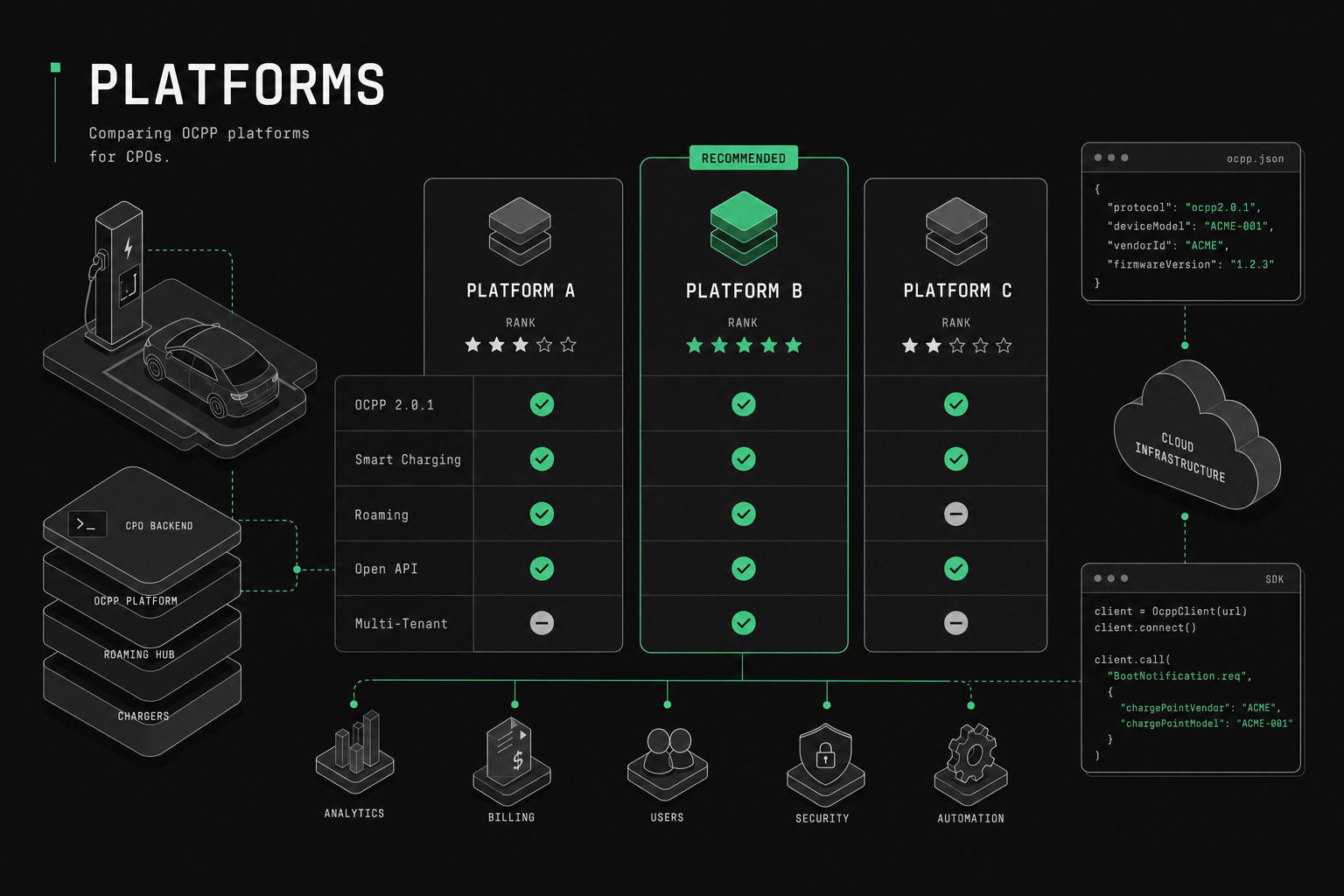
CPOs usually choose between three broad categories:
- Full EV charging suites
- White-label charging platforms
- Infrastructure layers (OCPP gateway / OCPP proxy) for routing and interoperability
Those are not interchangeable. Each one optimizes for a different buyer: one wants packaged workflows, one wants a branded product to resell, and one wants an open layer to compose around existing systems.
If you compare them as if they were, your shortlist will look clean but your implementation will still hurt. In our experience reviewing CPO migrations, the most expensive mistakes are picked at this stage, before anyone has looked at a single screen. A team standardizes on a packaged suite, then discovers six months later that their legacy OCPP chargers cannot be cut over in waves, and the rollback path means re-pointing firmware on every unit in the field.
Category 1: What is a full EV charging suite?
Full suites combine charger management, operational workflows, commercial tooling, and broader platform controls into one opinionated product. They suit operators who want a packaged stack and are comfortable standardizing on a single vendor.
These vendors are often attractive when:
- You want a broad packaged product
- You are comfortable standardizing on one vendor stack
- You prefer a more opinionated way of working
Examples teams often evaluate in this category include Driivz and ChargePoint, depending on deployment model and geography. The tradeoff is depth versus flexibility. A suite gives you a coherent operational surface out of the box, but the same opinionated design that speeds rollout can make non-standard integrations, custom tariff logic, or multi-backend routing harder to bolt on later. We typically see this surface when an operator inherits a mixed-vendor fleet and needs charger-specific quirk handling that the suite was never built to expose. Before committing, pressure-test how the suite handles OCPP 2.0.1 security profiles and firmware updates across charger models you actually run, not the reference models in the demo.
Category 2: What is a white-label charging platform?
White-label platforms give you a brandable product and ready-made admin and customer workflows, so you can go to market quickly without composing the stack yourself. They suit teams that value packaged surface area over deep architectural control.
These platforms are often attractive when:
- You want a more complete admin and customer workflow layer
- You want branding control
- You prefer to buy product surface area rather than compose it
AMPECO often shows up in this bucket for many buyers. The thing to watch here is the boundary between what is configurable and what is hard-coded. White-label products move fast because they make decisions for you, which is exactly the point. But when a partner needs a bespoke roaming arrangement, a custom CDR format, or an OCPI peering that the platform did not anticipate, you can hit a wall that no amount of configuration clears. In practice, the question that separates a good fit from a painful one is simple: how much of the workflow can your own team change without filing a feature request with the vendor?
Category 3: What is an infrastructure layer?
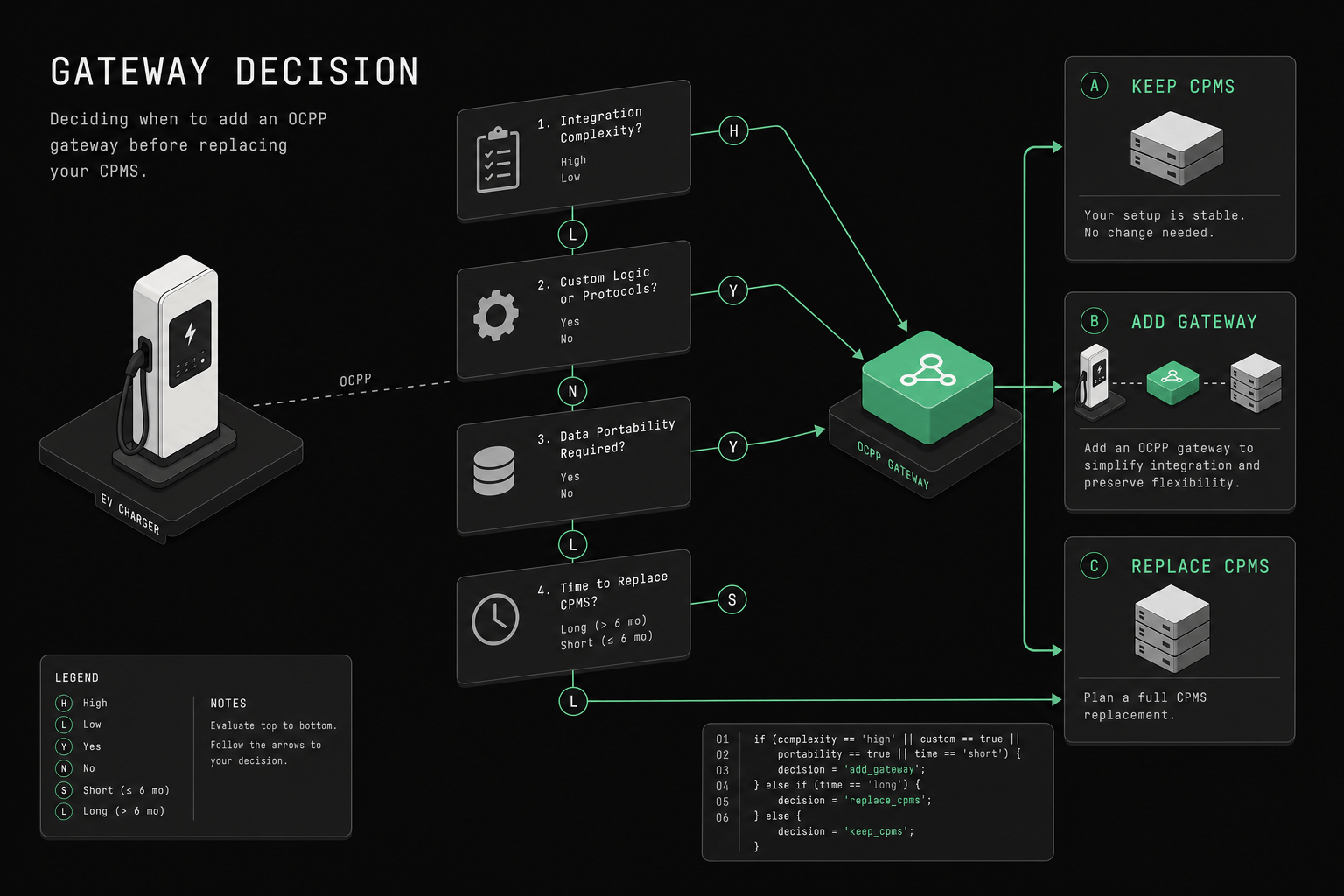
Infrastructure layers sit beneath or beside your existing systems and focus on connectivity, routing, and interoperability rather than packaged workflows. They suit operators who want to keep architectural control and avoid hard lock-in. This is the category ev-cloud is built for.
The goal here is not only to manage chargers, but to give operators an open layer for:
- OCPP connectivity
- Multi-backend routing
- Migration without charger-by-charger reconfiguration
- OCPI and partner interoperability
- Better data control
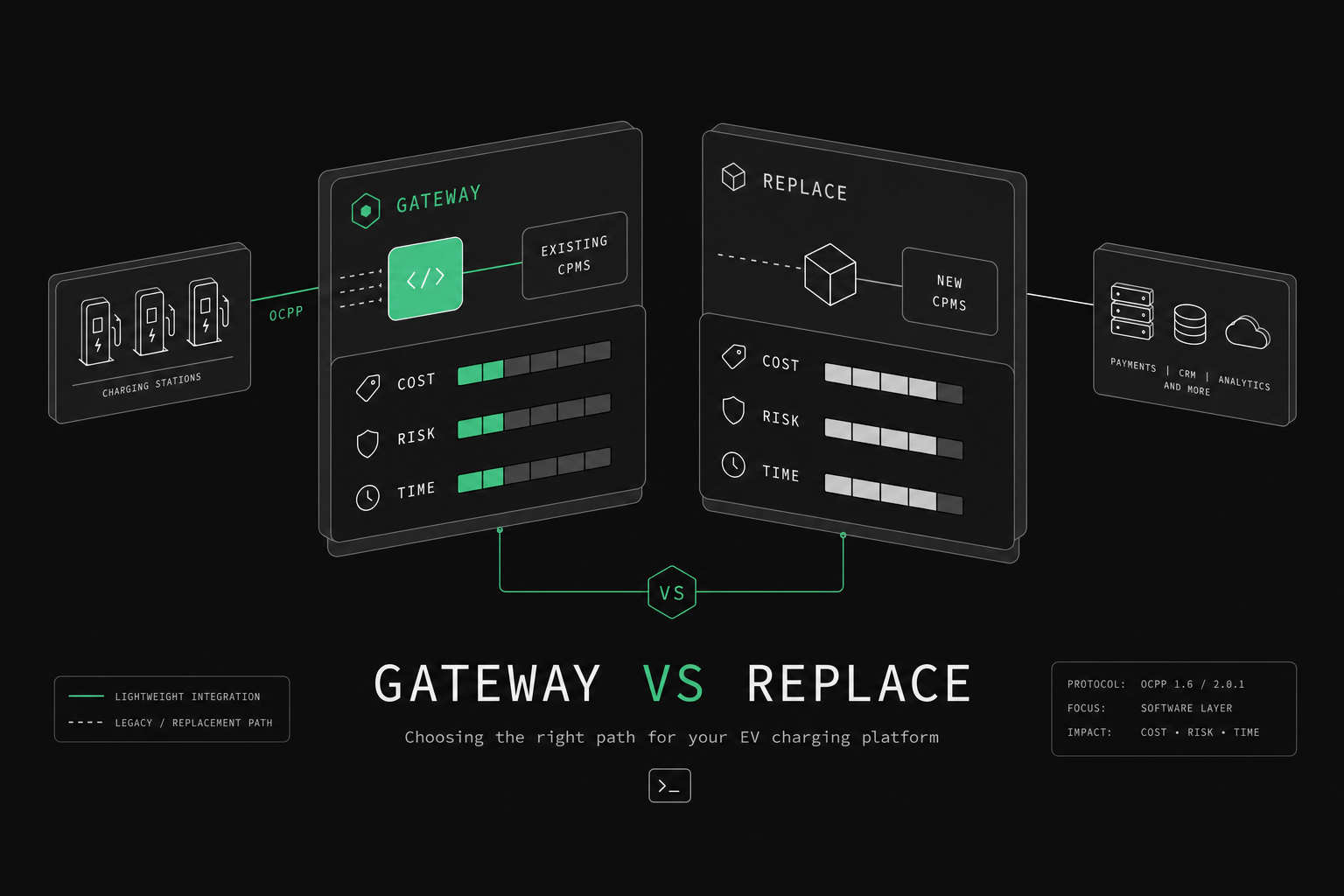
This is often the best fit for brownfield fleets, mixed backend environments, and teams that want to avoid hard lock-in. The defining capability is routing: chargers connect once to the layer, and the layer decides which backend each message reaches. That indirection is what lets you migrate a site in waves, run an old and new CSMS in parallel, and roll back without touching firmware in the field. In mixed-fleet rollouts the failure you are trying to design around usually shows up the same way: a charger model that silently drops its connection when the central system URL changes, forcing a truck roll. A routing layer absorbs that change instead of pushing it down to the hardware. See how this works in our legacy CSMS migration plan for CPOs.
Comparing the three platform categories
The three categories trade off the same axes in opposite directions: packaged depth versus architectural control, speed to launch versus migration safety, and predictable workflows versus open data and routing. The scorecard below is a qualitative starting point, not a vendor ranking, and your weighting should follow your own estate.
| Criterion | Full suite | White-label platform | Infrastructure layer |
|---|---|---|---|
| Primary buyer | Single-stack operator | Reseller or brand owner | Brownfield / mixed-fleet operator |
| Packaged workflows | Strongest | Strong | Composed, not packaged |
| Architectural flexibility | Lower | Lower to medium | Highest |
| Staged, wave-based migration | Often limited | Often limited | Designed in |
| Multi-backend routing | Rare | Rare | Core capability |
| OCPI / partner interoperability | Varies | Varies | Core capability |
| Data ownership and export | Varies by contract | Varies by contract | Open by design |
| Lock-in risk | Higher | Higher | Lower |
| Time to first launch | Fast | Fastest | Moderate |
Read every "varies" row as a question for the RFP, not an answer. Two suites in the same category can land on opposite sides of data portability depending on contract language.
What should you compare across every platform?
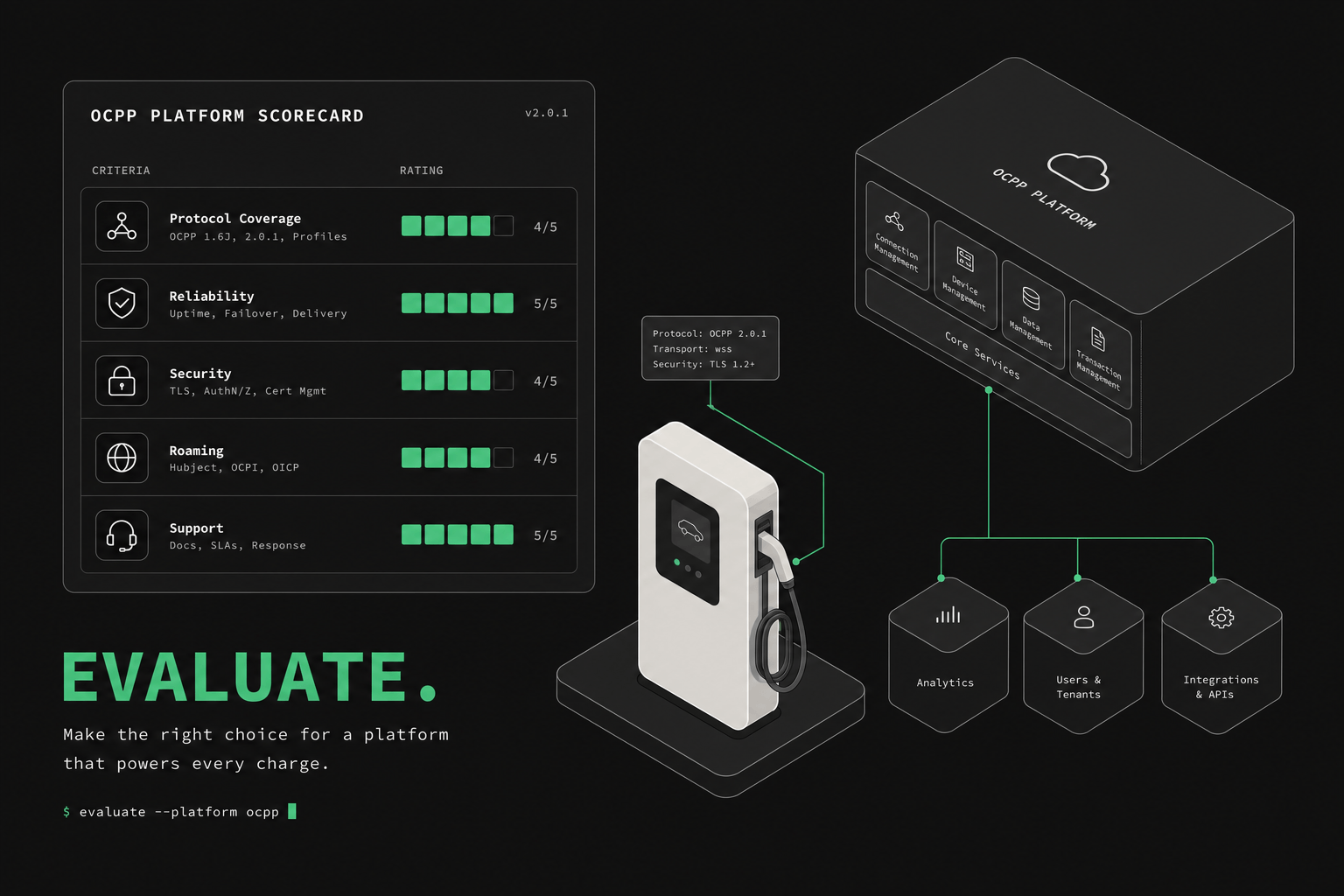
Compare every platform on five things: charger and protocol support, migration flexibility, interoperability, data ownership, and commercial risk. These cut across all three categories, and they predict implementation pain far better than feature checklists do. No matter which category a vendor falls into, compare them on these criteria:
1. Charger and protocol support
- OCPP 1.6 and 2.0.1 support
- Real mixed-fleet behavior
- Security profile handling
- Vendor-specific charger quirks
2. Migration flexibility
- Can you migrate in waves?
- Can you run old and new systems in parallel?
- Is rollback possible without touching chargers?
3. Interoperability
- OCPI support
- Multi-backend routing
- Export APIs and event access
- External integrations
4. Data ownership
- Access to sessions and CDRs
- Historical export
- Raw events
- Contract language around data use and portability
5. Commercial risk
- Per-charger pricing behavior at scale
- Extra fees for integrations
- Professional services dependency
- Exit and transition support
How should CPOs build a shortlist?
Build the shortlist around your operating model first, then map two or three vendors to it. Starting from operating model keeps you from comparing a white-label product against an infrastructure layer as if they solved the same problem. Here is a useful way to think about it:
If you want an open infrastructure layer
Use the buyer guide scorecard to compare any vendor against the same axes. ev-cloud does not publish per-vendor comparison pages.
How to use this post
Use this article as the shortlist map, not the final decision tool. It tells you which category to weight and which vendors to put in the room; the scoring and procurement work happens in the steps below.
Then:
- Use the OCPP platform buyer guide for scoring criteria.
- Use the EV charging software RFP checklist for procurement questions.
- Use the solutions hub to map the operating model to a product landing.
That order usually leads to much better buying decisions than starting with sales demos. The pattern we see repeatedly: teams that score against their own estate before booking demos avoid being anchored on whichever feature a vendor chose to lead with. When you are ready to weigh a specific tradeoff against your fleet, talk to our team or learn more in our ultimate guide to OCPP.